

Cell-Free Protein Synthesis with ALiCE® Delivers a Functional, Native-Like Membrane Receptor Tyrosine Kinase
Receptor tyrosine kinases (RTKs) are proteins of high clinical relevance, but they are notoriously difficult to express in conventional cell-based systems due to their structural complexity and membrane-bound nature. In a recent publication from the University of Leeds by Snow et al. in Nature Portfolio’s Scientific Reports, the ALiCE® cell-free expression system, when combined with SMA copolymer encapsulation, was successfully used to produce full-length, functional FGFR3-TACC3, an oncogenic RTK fusion that has been difficult to express using conventional methods.1 Besides successful expression, what makes the research so notable is that the cell-free expressed protein retained its functionality and dimerized in the same way as the native protein. This marks the first step towards obtaining a high-resolution structure of a full-length RTK.
High-Priority Targets with Major Expression Challenges
RTKs are a class of membrane-bound receptors that regulate essential cellular processes, including proliferation, differentiation, metabolism, and cell-cycle control. They function as signaling hubs, transmitting extracellular signals into the cell to regulate key pathways. Mutations and dysregulation of RTKs are implicated in numerous diseases, particularly cancers, where aberrant activity in RTKs such as EGFR, FGFRs, or VEGF, to name a few, drives uncontrolled cell growth and tumor progression. As a result, RTKs have emerged as valuable drug targets, with therapies designed to inhibit their signaling proving effective in oncology and other disease areas.2 Examples of therapeutics targeting RTK biology include Avastin®, Herceptin® and Lucentis®.4
Despite their clinical significance, structural studies of RTKs remain challenging due to major technical limitations in their expression and purification. Their complex, large structure, which includes an extracellular ligand-binding domain, a single transmembrane helix, and an intracellular kinase domain, makes them inherently difficult to express in sufficient quantities using traditional cell-based expression systems. Consequently, no high-resolution structure of a full-length RTK has been published to date, limiting our ability to design more precise therapeutics.3.
A Dual Approach Combining Cell-Free Expression and SMA Copolymer Encapsulation to Deliver Functional FGFR3-TACC3
FGFR3-TACC3 is an oncogenic RTK fusion implicated in glioblastoma, bladder cancer, and other malignancies. Oncogenic fusions of RTKs are particularly difficult to express in conventional cell-based systems due to their high flexibility, tendency to aggregate, and difficulties in extraction within a native lipid environment. FGFR3 also possesses N-glycosylation and disulfide bond sites.
The study of Snow et al. in Scientific Reports demonstrates how the research team successfully overcame these challenges using two complementary technologies: ALiCE® cell-free expression platform and SMA copolymer encapsulation.1 ALiCE® enabled rapid, high-yield production of functional FGFR3-TACC3 without the limitations of cell-based systems, ensuring proper folding and enzymatic activity. To maintain its structural integrity, the team further utilized SMA copolymers, which encapsulated the protein within a lipid environment, preserving its native conformation.
The FGFR3-TACC3 oncoprotein was expressed in under 48 hours, with impressive yields of approximately 300 µg/mL of lysate. Functional validation via ADP-Glo kinase activity assay and mass photometry for ligand binding to fibroblast growth factor 1 confirmed key properties of the expressed protein, demonstrating its native-like quality.
Furthermore, the study highlighted that conventional cell-based systems failed to produce sufficient FGFR3-TACC3 for comparative studies, reinforcing the advantages of ALiCE® in overcoming these expression barriers. This dual-technology approach represents a major step forward in enabling high-resolution structural studies of oncogenic RTK fusions.1
Cell-Free with ALiCE® for Challenging Membrane Protein Expression
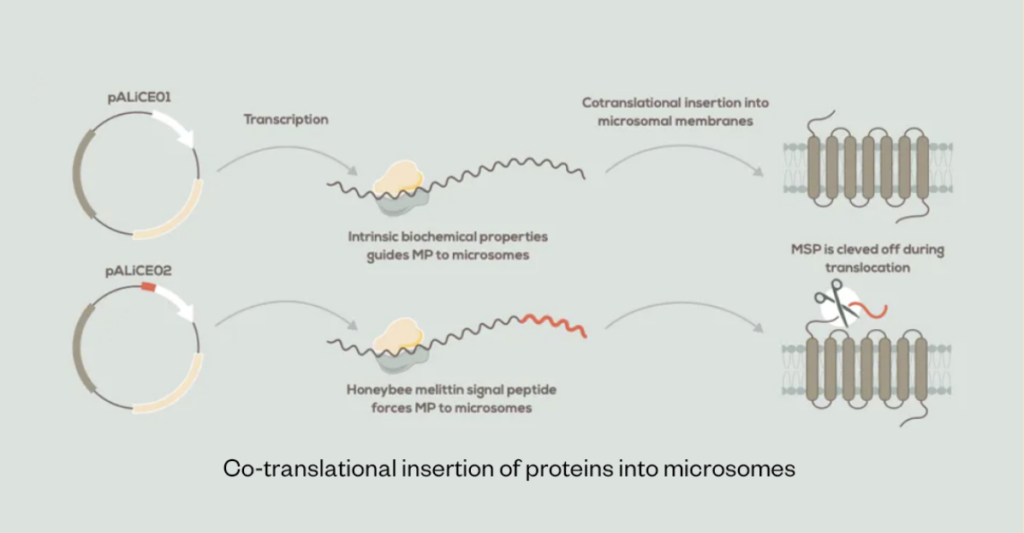
One of the defining advantages of ALiCE® is its ability to produce membrane proteins in a way that closely mirrors their natural biological context. ALiCE® incorporates native microsomes derived from the endoplasmic reticulum and Golgi, enabling co-translational integration of proteins into lipid structures. This natural insertion process improves the chances of obtaining properly folded, functionally active membrane proteins.
Enabling Complex Post-Translational Modifications
Similarly, ALiCE® inherently supports complex post-translational modifications essential for membrane protein functionality. It facilitates the incorporation of glycosylation and disulfide bonds, processes crucial for protein stability and interaction with other biomolecules. Additionally, its compatibility with eukaryotic chaperones ensures proper protein folding, eliminating the need for extensive optimization steps typically required in other expression platforms.
No Requirement for Additional Co-Factors
With ALiCE®, researchers can generate functionally active membrane proteins in 24–48 hours. This rapid production cycle allows for faster iterations in experimental workflows, saving valuable time in protein characterization and drug screening. This is in addition to the time saved by bypassing cell culture which can delay timelines.
Expedited Protein Production Timeline
With ALiCE®, researchers can generate functionally active membrane proteins in 24–48 hours. This rapid production cycle allows for faster iterations in experimental workflows, saving valuable time in protein characterization and drug screening. This is in addition to the time saved by bypassing cell culture which can delay timelines.
Scalable Production
ALiCE® is highly scalable, currently supporting reaction volumes up to 10 liters—making it suitable for both small-scale research applications and large-scale protein production.
Scalable Production
The successful expression of FGFR3-TACC3 in ALiCE® represents a critical step toward obtaining high-resolution structural data on full-length RTKs. With a scalable and efficient cell-free protein expression workflow now available, researchers can explore dimerization properties, ligand interactions, and other biophysical aspects that were previously inaccessible due to expression limitations. Furthermore, the success of FGFR3-TACC3 production implies that ALiCE® can be adapted for a broader range of difficult membrane proteins, making it a valuable tool for drug discovery and structural biology.
References
Manzer, Z. A., Selivanovitch, E., Ostwalt, A. R., & Daniel, S. (2023). Membrane protein synthesis: no cells required. Trends in biochemical sciences, 48(7), 642–654. https://doi.org/10.1016/j.tibs.2023.03.00
Snow, A. J. D., et al. (2025). Cell-free expression and SMA copolymer encapsulation of a functional receptor tyrosine kinase disease variant, FGFR3-TACC3. Scientific reports, 15(1), 2958. https://doi.org/10.1038/s41598-025-86194-6
Lemmon, M. A., & Schlessinger, J. (2010). Cell signaling by receptor tyrosine kinases. Cell, 141(7), 1117–1134. https://doi.org/10.1016/j.cell.2010.06.011
Rygiel, K. A., & Elkins, J. M. (2023). Recent advances in the structural biology of tyrosine kinases. Current opinion in structural biology, 82, 102665. https://doi.org/10.1016/j.sbi.2023.102665
Ebrahimi, N., et al. (2023). Receptor tyrosine kinase inhibitors in cancer. Cellular and molecular life sciences : CMLS, 80(4), 104. https://doi.org/10.1007/s00018-023-04729-4